
Contents:
Parts Usually Used | Plant(s) & Culture | Where Found | Medicinal Properties
Uses | Formulas or Dosages | Bibliography
Scientific Names
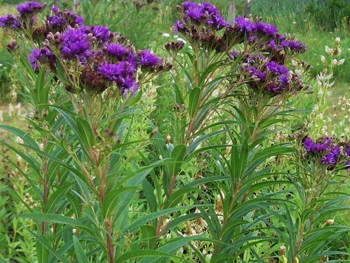
- Vernonia fasciculata L.
- Compositae
- Composite family
Parts Usually Used
Root, leaves
Back to Top
Description of Plant(s) and Culture
Ironweed is a coarse, perennial plant; the simple, glabrous stem grows 2-10 feet high and bears alternate, ascending, purplish-green, linear or oblong-lanceolate leaves, 4-8 inches long. The reddish-purple or purple flowers grow in dense cymes of short-peduncled heads, somewhat like miniature thistles, from July to September.
Another variety: Also called ironweed, (V. glauca) is a blue-green perennial, 2-5 feet tall. Leaves are on stems only, not at the base; oval to lance-shaped and narrowly sharp-pointed at the tip and base. Flowers July to October. Seed crowns are yellowish. Found in rich woods; New Jersey to Georgia; Alabama to Pennsylvania. The root used by Native Americans as a blood tonic, to regulate menses, relieve pain after childbirth, and for bleeding, and stomachaches.
Back to Top
Where Found
Grows in woods, on prairies, and along riverbanks and streambanks in the states west of Ohio.
Back to Top
Medicinal Properties
Bitter tonic, deobstruent, alterative
Back to Top
Uses
The root is taken in the form of a powder or a decoction primarily to stimulate appetite and promote digestion. Useful for female complaints, amenorrhea, dysmenorrhea, leucorrhea, and menorrhagia. A remedy for chills and fevers, scrofula, diseases of the skin, syphilis. A decoction of the leaves is used as a gargle for sore throat.
Back to Top
Formulas or Dosages
Decoction: use 1 tsp. rootstock with 1 cup water. Take 1-2 cups per day, 1/2 to 1 hour before meals.
Back to Top
Bibliography
 Eastern/Central Medicinal Plants
The Herb Book
Indian Herbalogy of North America
Webster’s New World Dictionary
