
Contents:
Common Names | Parts Usually Used | Plant(s) & Culture | Where Found | Medicinal Properties | Biochemical Information
Legends, Myths and Stories | Uses | Formulas or Dosages | Resource Links | Bibliography
Scientific Names
- Stachys byzantina
- Stachys lanata
- Stachys olympica
- Lamiaceae family
Common Names
- Big Ears
- Lamb’s Tongue
- Silver Carpet
- Wood Betony
- Woolly Betony
- Woolly Hedgenettle
Parts Usually Used
Leaves
Back to Top
Description of Plant(s) and Culture
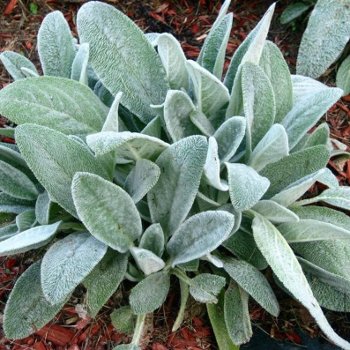
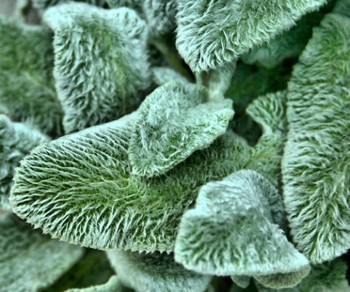
Lamb’s Ear can grow to a height of 12-18 inches in hardiness zones 4-8 and yields tall purple flower heads in May through July. The fuzzy leaves of the plant produce a smell like that of apple when crushed. The flowering spikes are 10–22 cm long, producing verticillasters that each have many flowers and are crowded together over most of the length on the spike-like stem.
For maximum medicinal properties, harvest the aerial parts of the plant in mid-summer as it is beginning to flower.
Here are some of the more common cultivars :
- Big Ears – leaves very large, up to 25 cm long.
- Cotton Boll – a sterile cultivar that does not produce flowering stems. Asexually propagated.
- Primrose Heron – leaves yellow in spring; flowers pink
- Sheila Macqueen – sterile; low-growing; leaves large.
- Silky Fleece – grows 25 cm tall with lilac-plum flowers, produce smaller white-woolly foliage. Seed propagated.
- Silver Carpet – sterile; leaves grey. Asexually propagated.
- Striped Phantom – leaves variegated.
Where Found
Lamb’s ear is native to Turkey, Armenia, and Iran, but it is cultivated over much of the temperate world as an ornamental plant
Back to Top
Medicinal Properties
Its vulnerary, antiseptic, anti-spasmodic, and astringent properties come from the flavonoids and iridoids present within the plant.
Stachys byzantina extract has shown antimicrobial activity against Staphylococcus aureus that is resistant to vancomycin.
Back to Top
Biochemical Information
Chemical constituents of the plant include betonicine, stachydrene, and trigonelline, all of which are alkaloids. Tannins are also present in the plant.
Back to Top
Legends, Myths and Stories
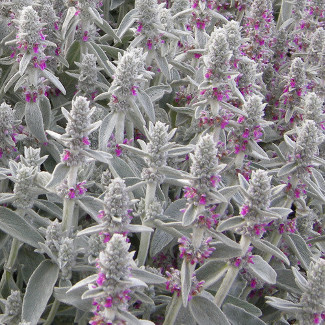
The plant is sometimes called Silver Carpet because of its silvery appearance in moonlight.
Some superstitious people believe Lamb’s Ear to possess the magical powers to heal emotional and spiritual wounds.
Often planted in children’s gardens because it’s so fun to touch.
The Boy Scouts used to use lamb’s ear for toilet paper.
Bandages of Lamb’s Ear were applied to wounds and bruises in medieval times due to their effectiveness in wound healing.
Lambs Ear is quite popular for a multitude of insects and Hummingbirds but in particular bees. One special type of bee known as the Wool Carder Bee actually collects the fuzz off of the Lamb’s Ear’s leaves to use for making nests in decayed wood.
Bumble bees like to congregate in morning hours to collect water in the form of condensation that collects on the fuzz of the Lamb’s Ear’s leaves.
Back to Top
Uses
Lamb’s ear has a sedative effect on the central nervous system, but it has been indicated for use in many other conditions including, but not limited to, dropsy, hypertension, dyspepsia, bladder stone, asthma, depression, gout, headache, kidney stone, nephrosis, neuralgia, menstrual cramps, joint pains, diarrhea relief, dysentery, and sore throat.
Because of its antiseptic properties, the plant is an effective wound healer and may be used as a bandage, poultice, wash, or mouthwash for the healing of wounds, including cankers of the mouth.
Back to Top
Formulas or Dosages
An infusion may be prepared by allowing one teaspoon of the dried aerial parts to steep in one cup of boiling water for 10-15 minutes. The infusion should be drunk three times daily to ease menstrual cramps, joint pains, diarrhea relief, and for dysentery. A tincture may also be prepared for the same use, and should be taken in the amount of one to two milliliters, three times daily.
For treatment of headache and neuralgia from anxiety and nervousness, an infusion may be prepared from 1-2 teaspoons of the dried aerial parts infused in boiling water for 10-15 minutes. The infusion may be drunk three times daily. Alternatively, 2-6 milliliters of a tincture made from the aerial parts may be taken three times daily.
Back to Top
Resource Links
The Medicinal Herb Gardens at ONU: Lamb’s Ear: Stachys byzantina, Lamb’s Toungue, Woolly Betony
Denton County Master Gardener’s Association: Lamb’s Ear
Missouri Botanical Gardens: Stachys byzantina
Bibliography
 The Complete Medicinal Herbal
