
Contents:
Common Names | Parts Usually Used | Plant(s) & Culture | Where Found | Medicinal Properties
Legends, Myths and Stories | Uses | Warning | Bibliography
Scientific Names
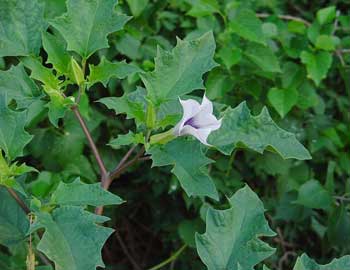
- Datura stramonium L.
- Nightshade family
Common Names
- Apple Peru
- Devil’s apple
- Devil’s trumpet
- Dhatura
- Feng-ch’ieh-erh (Chinese name)
- Jamestown weed
- Jimpson weed
- Mad-apple
- Nightshade
- Peru-apple
- Stinkweed
- Stinkwort
- Stramonium
- Thorn-apple
Parts Usually Used
Leaves, root, seed
Back to Top
Description of Plant(s) and Culture
A poisonous annual weed of the nightshade family, with foul-smelling leaves, prickly fruit, and white or purplish, trumpet-shaped or funnel-shaped flowers and is hallucinogenic. A large, whitish root produces the round, glabrous, yellowish-green, branching stem which grows 1-5 feet high. The leaves are alternate, dark green above and lighter beneath, ovate, and irregularly incised and toothed. The flowers are large, white, and showy; grow on short peduncles in the axils of the branches from June to September. The slightly spiraled blooms make this plant easy to identify. The four-parted, chambered, spiny seedpods are distinctive, too. The fruit is an ovate, prickly capsule containing many black seeds.
Although this plant produces useful alkaloids, it is violently toxic.
Another variety: Another plant (Datura meteloides) was known as Jimson Weed by the Native Americans. They made a tea of the plant to wash a horse with it when he tried to stray. They called the plant “Moip.” It has a heavy root, which when soaked, ground and boiled, the tea renders the drinker unconscious. The drinker has visions, but must be watched to prevent wandering off in search of some lost article.
Back to Top
Where Found
Found in Europe, Asia, and North and South America. A fetid plant found in waste places, pastures, old fields, gardens, and roadsides. Usually found in sandy soil.
Back to Top
Medicinal Properties
Anodyne, antispasmodic, hypnotic, narcotic.
Back to Top
Legends, Myths and Stories
Jimsonweed has an interesting history; it was/is used in witchcraft or wicca.
It has been used for hallucinogenic and medicinal purposes since ancient times. The Greek priests of Apollo used it to produce prophecies. In 38 BC Antony’s soldiers ate some of the plant while retreating and became ridiculously incoherent. The plant’s name is derived from a similar incident involving soldiers in Jamestown in 1676. They too ate the plant and were good for little but clowning for eleven days. As a result, the plant came to be called Jamestown weed, which evolved into jimson weed.
Its use was supposedly introduced to medieval Europe by gypsies who brought it from India. The gypsies smoked it to experience hallucinations. Because it also gives the sensation of flying and releases inhibitions, especially in women, jimson weed was associated in the Middle Ages with witchcraft, Witches inhaled its vapors while casting spells.
Jimson weed has been taken for its narcotic and hallucinogenic effects by Native American tribes from the southwestern United States to South America. Many tribes used it to induce visions in priests, medicine men, and puberty rites. The Zuni and many California Indian tribes set broken bones after administering jimson weed as an anesthetic. The Mariposa Indians gave it to its women as an aphrodisiac.
The name stinkweed refers to the narcotic odor which is unpleasant.
The plant is gathered in the fall and slowly dried in the shade.
Back to Top
Uses
Jimson weed is a dangerous plant in inexperienced hands, and an overdose is likely to be fatal.
A tincture is sometimes given for spasmodic coughing, chronic laryngitis, a narcotic poison, mania, epilepsy, delirium tremens (DTs), typhus, and asthma. Externally, used for neuralgia, bruises, swellings,saddle sores on horses, rattlesnake bites, tarantula bites, and rheumatism. The leaves have been made into cigarettes for smokers with asthma and other respiratory problems. In South America, jimson weed is believed to be an aphrodisiac.
The whole plant contains atropine and other alkaloids, used to dilate the pupils of the eyes; causes dry mouth, depresses bladder muscles, impedes action of the parasympathetic nerves; used in Parkinson’s disease; also contains scopolamine, used in patched behind the ear for vertigo. Folk cancer remedy.
Back to Top
Warning
Violently toxic. Causes severe hallucinations. Many fatalities reported.
Those who collect this plant may end up with swollen eyelids.
Do not ingest any part of jimson weed. Licorice (Glycyrrhiza) has been suggested as an antidote.
Keep this plant away from where children play. Do not use without medical supervision. An overdose may be fatal.
Back to Top
Bibliography
 The Herb Book
Chinese Medicinal Herbs
Indian Uses of Native Plants
Indian Herbalogy of North America
Eastern/Central Medicinal Plants
Herbal Gardening, compiled by The Robison York State Herb Garden, Cornell Plantations, Matthaei Botanical Gardens of the University of Michigan, University of California Botanical Garden, Berkeley., Pantheon Books, Knopf Publishing Group, New York, 1994, first edition
The Yoga of Herbs: An Ayurvedic Guide to Herbal Medicine
Webster’s New World Dictionary
The Rodale Herb Book: How to Use, Grow, and Buy Nature’s Miracle Plants (An Organic gardening and farming book)
