
Contents:
Common Names | Parts Usually Used | Plant(s) & Culture | Where Found | Medicinal Properties
Uses | Formulas or Dosages | Warning | Bibliography
Scientific Names
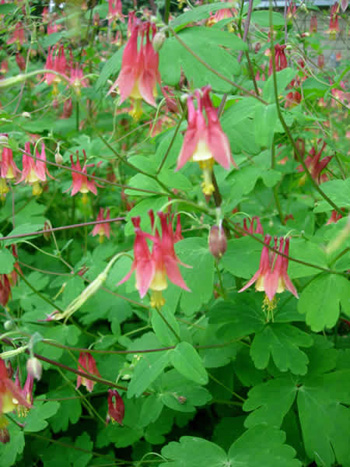
- Aquilegia vulgaris L.
- Aquilegia canadensis L.
- Buttercup family
Common Names
- Garden columbine
Parts Usually Used
The plant
Back to Top
Description of Plant(s) and Culture
Columbine is a perennial, herbaceous plant; its prominently branching stem is sparsely hairy and grows from 1 to 2 1/2 feet high. Both the basal and lower stem leaves are shaggy-haired underneath and biternate, with the leaflets or ultimate segments broadly wedge-shaped. The nodding blue, purple, or white flowers grow at the ends of the branches during the summer. Their 5 petals have characeristic nectar-containing, backward-projecting spurs about 3/4 inch long. Bloom in May.
Back to Top
Where Found
Originally came from Europe to be naturalized in the eastern United States. In moist, rich woods, wet, shaded rocky outcrops. Southern Canada southward.
Back to Top
Medicinal Properties
Astringent, diuretic, diaphoretic, anodyne
Back to Top
Uses
A decoction of the root helps stop diarrhea. The flowers taken with wine promote perspiration, and the seeds with wine are said to speed the delivery of a child, opens obstructions of the liver, good for jaundice, relieve kidney stones. Leaves are sometimes used in lotions to soothe sores in the mouth and throat. A lotion made from the fresh root is rubbed on the affected area to relieve rheumatic aches and pains.
Native Americans used minute amounts of crushed seeds for headaches, love charms, and fevers. Seeds rubbed into the hair to control lice. Root chewed or weak tea for diarrhea, stomach troubles, diuretic. Root tea for uterine bleeding.
Back to Top
Formulas or Dosages
Infusion: steep 1 tsp. plant parts in 1 cup water. Take 1 tbsp., 3-6 times a day.
Tincture: a dose is from 5-10 drops.
Back to Top
Warning
Potentially poisonous.
Back to Top
Bibliography
 Culpeper’s Complete Herbal & English Physician: Updated With 117 Modern Herbs
Eastern/Central Medicinal Plants
The Herbalist Almanac
The Herb Book
Webster’s New World Dictionary
