
Contents:
Common Names | Plant(s) & Culture | Where Found | Medicinal Properties
Legends, Myths and Stories | Uses | Formulas or Dosages | Nutrient Content | Bibliography
Scientific Names
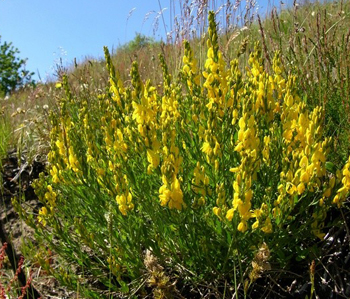
- Genista tinctoria L.
- Pea family
Common Names
- Dyer’s greenweed
- Dyer’s whin
- Furze
- Green broom
- Greenweed
- Waxen woad
- Woad waxen
- Wood waxen
Description of Plant(s) and Culture
Dyer’s broom is a perennial herbaceous shrub; grows 1-2 feet high, the stems are woody, slightly hairy, and branched. The alternate, nearly sessile leaves are glabrous and lanceolate. Golden-yellow flowers grow in narrow panicles from June to August. The fruit is a long, shiny pod shaped like a green-bean pod.
Back to Top
Where Found
Grows in dry uplands from Maine to Massachusetts and in eastern New York, also in meadows, pastures, and woods in Europe.
Back to Top
Medicinal Properties
Aperient, diuretic, stimulant vasoconstrictor, purgative
Back to Top
Legends, Myths and Stories
Woadwaxen was used by the ancient Britons for yellow dye.
There is another plant called Woad (Isatis tinctoria) of the cruciferae genus is also a dye plant. Woad is cultivated in Britain for the blue dye from the leaves.
Back to Top
Uses
Dyer’s broom tea acts as a mild purgative and has been recommended for gravel and stones. It stimulates the central nervous system (compared to that of nicotine). Dyer’s broom raises blood pressure by constricting the blood vessels and should be avoided when hypertension is present. The tincture of extract is used externally for herpes or tetters.
Back to Top
Formulas or Dosages
Infusion: steep 2 tsp. flowering twigs in 1/2 cup water. Take no more than 1 cup per day.
Back to Top
Warning
Dyer’s broom raises blood pressure by constricting the blood vessels and should be avoided when hypertension is present.
Back to Top
Bibliography
 The Herb Book
Webster’s New World Dictionary
The Rodale Herb Book: How to Use, Grow, and Buy Nature’s Miracle Plants (An Organic gardening and farming book)
