
Contents:
Common Names | Parts Usually Used | Plant(s) & Culture | Where Found | Medicinal Properties
Legends, Myths and Stories | Uses | Formulas or Dosages | Bibliography
Scientific Names
- Agave americana L.
- Manfreda virginica L.
- Agave virginica L.
- Agavaceae
- Agave family
Common Names
- American agave
- American centaury
- Century plant
- False aloe
- Flowering aloe
- Rattlesnake master
- Spiked aloe
Parts Usually Used
The plant
Back to Top
Description of Plant(s) and Culture
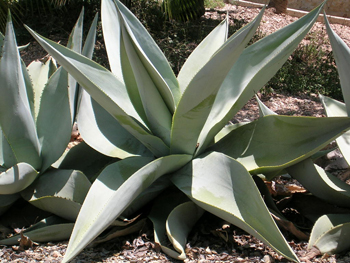
Agave is a perennial plant; the broad-linear, fibrous leaves grow upward from next to the ground to form a massive rosette. They are gray and smooth on both sides and have prickly edges. After 10 years or more, the plant produces a flower stalk which bears large yellowish-green flowers on many horizontal branches. The fruit is a 3-celled capsule. After flowering and fruiting, the plant dies.
Also called Agave (Manfreda virginica L.) also known as rattlesnake-master, and false aloe as well as the botanical name of (Agave virginica L.). Do not confuse this herb with another plant called Rattlesnake-master (Eryngium yuccifolium).
Back to Top
Where Found
Grows in the arid and semi-arid regions of tropical America and in some parts of Europe.
Back to Top
Medicinal Properties
Antiseptic, diuretic, laxative
Back to Top
Legends, Myths and Stories
The agave is considered the Mexican Tree of Life and Abundance, probably because the people of that region have had so many uses for it. It provides them with food, fodder, paper, twine, soap, roofing, dye, and alcoholic drinks. Its popular name century plant comes from the mistaken notion that it blooms only once in a hundred years. Actually, it flowers after 8-10 years and then dies.
Back to Top
Uses
The sap has antiseptic properties and is taken to stop the growth of bacteria in the stomach and intestine. Can also be used as a laxative. Used for syphilis. Recommended at times for pulmonary tuberculosis, diseased liver, and jaundice. Agave fiber soaked in water for a day is used as a scalp disinfectant and a tonic in cases of falling hair.
Back to Top
Formulas or Dosages
Decoction: boil
Powder: take
Back to Top
Nutrition Facts
- Serving Size: 1 x 100g 100
- Calories: 68
- Total Fat: 0.15 g
- Cholesterol: 0 mg
- Sodium: 14 mg
- Total Carbohydrate: 16.23 g
- Dietary Fiber: 6.6 g
- Sugars: 2.58 g
- Protein: 0.52 g
- Vitamin A: 37 IU
- Vitamin C: 4 mg
- Calcium: 417 mg
- Iron: 1.8 mg
- Ash: 1.27 g
- Starch: 0.24 g
- Sucrose: 0.41 g
- Glucose (dextrose): 1.19 g
- Fructose: 0.98 g
- Lactose: 0 g
- Maltose: 0 g
- Alcohol, ethyl: 0 g
- Water: 81.83 g
- Caffeine: 0 mg
- Theobromine: 0 mg
- Galactose: 0 g
- Magnesium, Mg: 55 mg
- Phosphorus, P: 7 mg
- Potassium, K: 127 mg
- Zinc, Zn: 0.15 mg
- Copper, Cu: 0.138 mg
- Manganese, Mn: 0.094 mg
- Selenium, Se: 0.4 mcg
- Retinol: 0 mcg
- Vitamin A, RAE: 2 mcg_RAE
- Carotene, beta: 22 mcg
- Carotene, alpha: 0 mcg
- Vitamin E (alpha-tocopherol): 0.23 mg
- Vitamin D: 0 IU
- Cryptoxanthin, beta: 0 mcg
- Lycopene: 0 mcg
- Tocopherol, beta: 0 mg
- Tocopherol, gamma: 0 mg
- Tocopherol, delta: 0 mg
- Thiamin: 0.029 mg
- Riboflavin: 0.039 mg
- Niacin: 0.162 mg
- Pantothenic acid: 0.041 mg
- Vitamin B-6: 0.055 mg
- Folate, total: 7 mcg
- Vitamin B-12: 0 mcg
- Vitamin K (phylloquinone): 5.3 mcg
- Folic acid: 0 mcg
- Folate, food: 7 mcg
- Folate, DFE: 7 mcg_DFE
- Tryptophan: 0.008 g
- Threonine: 0.014 g
- Isoleucine: 0.014 g
- Leucine: 0.025 g
- Lysine: 0.028 g
- Methionine: 0.009 g
- Cystine: 0.008 g
- Phenylalanine: 0.019 g
- Tyrosine: 0.009 g
- Valine: 0.022 g
- Arginine: 0.106 g
- Histidine: 0.008 g
- Alanine: 0.024 g
- Aspartic acid: 0.041 g
- Glutamic acid: 0.052 g
- Glycine: 0.019 g
- Proline: 0.013 g
- Serine: 0.021 g
- Vitamin E, added: 0 mg
- Vitamin B-12, added: 0 mcg
Bibliography
 The Herb Book
Eastern/Central Medicinal Plants
Indian Herbalogy of North America
Webster’s New World Dictionary
The Rodale Herb Book: How to Use, Grow, and Buy Nature’s Miracle Plants (An Organic gardening and farming book)
