
Contents:
Common Names | Parts Usually Used | Plant(s) & Culture | Where Found | Medicinal Properties | Biochemical Information
Legends, Myths and Stories | Uses | Formulas or Dosages | Warning | Bibliography
Scientific Names
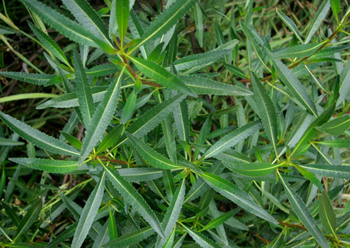
- Eriodictyon californicum L.
- Eriodictyon glutinosum
- Hydrophyllaceae
- Water leaf family
Common Names
- Bear’s weed
- Consumptive’s weed
- Gum bush
- Gum plant (Grindelia robusta L.)
- Mountain balm
- Tarweed
Parts Usually Used
Leaves
Back to Top
Description of Plant(s) and Culture
Yerba santa is an evergreen shrub; it is somewhat branching and grows to a height of 2-4 feet. The stems are smooth and exude a gummy substance. Leaves are 3-4 inches long, distinctively woolly on the undersides, containing a network of prominent veins, and the resinous substance appears as if the woolly fibers have been varnished; upper surface is smooth with depressed veins. The flowers are terminal, appearing in shades of dark lavender to pale shades of lavender to white; forming funnel-shaped clusters at the top of the plant. The honey is amber, with a slightly spicy flavor. Bees love this plant. The capsule fruit is oval, grayish-brown and contains small brown shriveled seeds.
Back to Top
Where Found
Follow the bees and find santa yerba on dry mountain slopes and ridges in the coastal ranges and up into the foothills of the Sierra Nevada from Monterey to Tulare northward.
Back to Top
Medicinal Properties
Aromatic, tonic, stimulant, expectorant
Back to Top
Biochemical Information
Eriodictyol, homoeriodictyol, chrysocriol, zanthoeridol and eridonel. Also free formic and other acids, glycerides of fatty acids, a yellow volatile oil, a phytosterol, resin and glucose.
Back to Top
Legends, Myths and Stories
The name yerba santa (means “Holy weed”) was given by the Spanish fathers who became aware of it through Native Americans.
The Native Americans smoked or chewed the leaves for asthma. The taste is peculiar, at first, when chewed, seems rather disagreeable, resinous, and bitter. This taste soon disappears and then tastes sweet and cooling, which is especially noticed when chewing stops a minute, or by drinking a glass of water. One Native American expressed it, “It makes one taste kind of sweety inside.”
Back to Top
Uses
Native Americans boiled the fresh or dried leaves for colds, coughs, sore throat, catarrh, asthma, bronchitis, hayfever, congestion due to allergies, laryngitis, fever, stomach aches, vomiting, diarrhea, hemorrhoids, kidney conditions, and rheumatism. Externally, Native Americans used the fresh or dried leaves as a poultice for broken or unbroken skin, fatigued limbs, insect bites, sprains, bruises, swellings, sores, poison ivy or poison oak rashes.
Back to Top
Formulas or Dosages
Infusion: 1 tsp. of crushed leaves to 1 cup of boiling water, steep 30 minutes. Take 1 cup per day.
Fluid extract: mix 10 to 20 drops in liquid daily.
Back to Top
Warning
Yerba santa should be used in small amounts as too large doses will irritate the kidneys.
Back to Top
Bibliography
 The Herb Book
Back to Eden
Old Ways Rediscovered
Earl Mindell’s Herb Bible
Planetary Herbology
Indian Herbalogy of North America
An Instant Guide to Medicinal Plants
The Yoga of Herbs: An Ayurvedic Guide to Herbal Medicine
The Rodale Herb Book: How to Use, Grow, and Buy Nature’s Miracle Plants (An Organic gardening and farming book)
