
Contents:
Common Names | Parts Usually Used | Plant(s) & Culture | Where Found | Medicinal Properties | Biochemical Information
Legends, Myths and Stories | Uses | Nutrient Content | Warning | Bibliography
Scientific Names
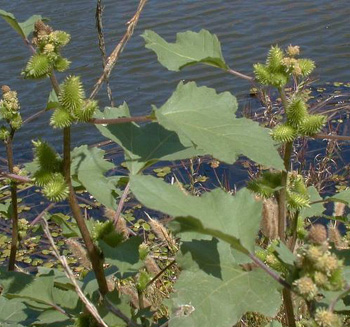
- Xanthium strumarium L.
- Compositae
- Composite family
Common Names
- Cocklebur
- Hsi-erh (Chinese name)
Parts Usually Used
Leaves, root
Back to Top
Description of Plant(s) and Culture
Cocklebur is a variable weedy annual plant that grows to 5 feet in height. The leaves are oval to heart-shaped, somewhat lobed or toothed, on long stalks. The green flowers are inconspicuous. The fruits are oval, with crowded hooked prickles, often called burrs. Blooms September to November.
Back to Top
Where Found
Found in waste places.
Back to Top
Medicinal Properties
Antispasmodic, analgesic, alterative, antibacterial, antifungal, diuretic, febrifuge, sedative
Back to Top
Biochemical Information
Xanthostrumarin, resin, fatty oil, alkaloids, organic acid, vitamin C, ceryl alcohol
Back to Top
Legends, Myths and Stories
This weed is very obnoxious to contact; the seed pods tend to adhere to animal fur and human clothing. Often transplanted throughout an area by clinging to the fur of animals and dropping at distances to become wider spread and more obnoxious. It is a very valuable therapeutic medicinal used by the Chinese for rheumatic pains and aches as well as sinus blockage. Also used as a yellow dye.
Agrimony (Agrimonia eupatoria L.) is sometimes called cocklebur, but this herb belongs to the rose family and is no relation to the true cocklebur (Xanthium strumarium L.)
Back to Top
Uses
Cocklebur was once used for rabies, fevers, malaria, sinusitis, allergic rhinitis with headaches, chronic lumbago, leprosy, and pruritis (severe itching) of the skin. Native Americans used the leaf tea for kidney diseases, rheumatism, arthritis, tuberculosis (TB), colds, as a blood tonic, and diarrhea. The Chinese had similar uses.
Back to Top
Nutrient Content
Vitamin C
Back to Top
Warning
Most cocklebur species are toxic to livestock and are usually avoided by them. Seeds contain toxins, but the seed oil has served as lamp fuel.
Back to Top
Bibliography
 American Folk Medicine
Chinese Medicinal Herbs
Eastern/Central Medicinal Plants
Indian Herbalogy of North America
Planetary Herbology
Webster’s New World Dictionary
The Rodale Herb Book: How to Use, Grow, and Buy Nature’s Miracle Plants (An Organic gardening and farming book)
