
Contents:
Common Names | Parts Usually Used | Plant(s) & Culture | Where Found | Medicinal Properties
Legends, Myths and Stories | Uses | Warning | Bibliography
Scientific Names
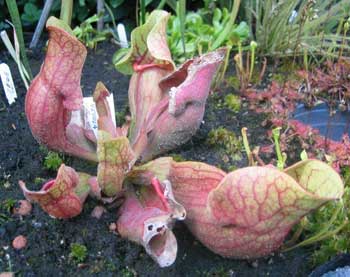
- Sarracenia purpurea L.
- Sarraceniaceae
- Order: Nepenthales
- Pitcher-plant family
Common Names
- Eve’s cup
- Flytrap (not the Venus flytrap)
- Huntsman’s cup
- Smallpox plant
- Watercup
Parts Usually Used
Root, leaves
Back to Top
Description of Plant(s) and Culture
Pitcher plant is a native North American unique perennial plant, 8-24 inches high; a horizontal, round rootstock produces the basal, pitcherlike, purple-veined leaves which are topped by an arching hood and are hairy and sticky on the inside, to trap insects, which the plant consumes. A solitary, large, red or purple flower nods on a naked flower stalk 1-2 feet high during May and June.
Back to Top
Where Found
Grows in swamps, peat or sphagnum bogs, savannas, wet meadows, and wet areas from Maryland to Minnesota and in Canada. Also in California and Oregon.
Back to Top
Medicinal Properties
Astringent, diuretic, stimulant, tonic
Back to Top
Legends, Myths and Stories
Various plants with slippery, pitcher-like leaves that contain a pool of enzymes that digest trapped insects are called pitcher plants. Most of these grow in swamps and bogs.
The “pitchers” have smooth surfaces and downward-pointing hairs, making it difficult for insects to crawl out. Once the insect drowns, the leaves secrete enzymes that digest the insect’s soft body parts, which allows the plant to obtain nutrients that would otherwise be unavailable in its habitat.
Back to Top
Uses
Used to stimulate appetite and improve digestion. Its most interesting use; Native Americans used an infusion of the rootstock against smallpox, both to prevent immunity and to lessen the severity of the disease. It was rejected by the medical profession in the 19th century as ineffective for this purpose, but the evidence was not conclusive on either side.
Back to Top
Warning
May be a threatened species; best left undisturbed in the wild.
Back to Top
Bibliography
 Eastern/Central Medicinal Plants
The Herb Book
How Indians Use Wild Plants for Food, Medicine & Crafts
Webster’s New World Dictionary
The Rodale Herb Book: How to Use, Grow, and Buy Nature’s Miracle Plants (An Organic gardening and farming book)
