
Contents:
Common Names | Parts Usually Used | Plant(s) & Culture | Where Found | Medicinal Properties
Legends, Myths and Stories | Uses | How Sold | Warning | Bibliography
Scientific Names
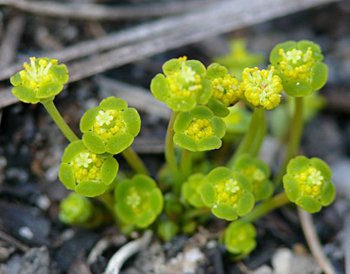
- Euphorbia ipecacuanhae L.
- Madder family
Common Names
- Wild ipecac
Parts Usually Used
Leaves, root
Back to Top
Description of Plant(s) and Culture
Wild ipecac is a large-rooted perennial with underground stems; the plant grows 3-12 inches tall with a stem that is smooth, succulent. The leaves are inserted at the joints; rounded to linear, green to purple. Solitary flowers are on long stalks; the “cups” have 5 glands, with narrow, white, yellow, green, or purple appendages. Blooms in April to May.
Back to Top
Where Found
Found in sandy soil; mostly coastal. New Jersey to Florida. Found in southwestern Brazil.
Back to Top
Medicinal Properties
Emetic, laxative, vermifuge
Back to Top
Legends, Myths and Stories
Because it induces vomiting, this herb is often abused by teenage girls suffering from bulimia, an eating disorder characterized by gorging and purging.
Back to Top
Uses
Native Americans used the leaf tea for diabetes; root tea as a strong laxative and emetic, for pinworms, rheumatism; poulticed the root on snakebites. This herb induces vomiting and is therefore a good remedy for food poisoning and other kinds of ingested poisoning.
Back to Top
How Sold
Sold as Syrup of Ipecac in pharmacies
Back to Top
Warning
It is not always appropriate to induce vomiting in cases of poisoning. Call your doctor or the local poison alert hotline before inducing vomiting or giving any drug to a poison victim.
Extremely strong laxative. The juice from the fresh plant may cause blistering. The herb is very toxic except in diluted syrup form.
Keep out of the reach of children and teenagers.
Back to Top
Bibliography
 American Folk Medicine
Earl Mindell’s Herb Bible
Eastern/Central Medicinal Plants
Indian Herbalogy of North America
The Nature Doctor: A Manual of Traditional and Complementary Medicine
Webster’s New World Dictionary
