
Contents:
Common Names | Parts Usually Used | Plant(s) & Culture | Where Found | Medicinal Properties
Legends, Myths and Stories | Uses | Formulas or Dosages | Warning | Bibliography
Scientific Names
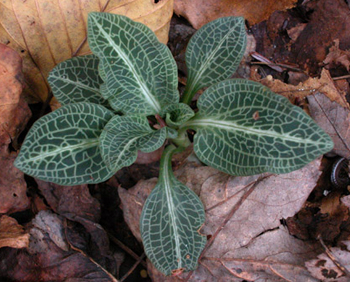
- Goodyera pubescens L.
- Orchid family
Common Names
- Adder’s violet
- Downy rattlesnake plantain
- Net-leaf plantain
- Networt
- Rattlesnake weed
- Scrofula weed
- Spotted plantain
- Water plantain
Parts Usually Used
Leaves, rootstock
Back to Top
Description of Plant(s) and Culture
Rattlesnake plantain is a perennial plant to 16 inches in flower; the fleshy, creeping rootstock produces dark green, basal, ovate leaves with networks of white veins. A glandular-hairy flower stalk with leaf-like, lanceolate scales bears a spike-like raceme of white or greenish-white flowers from July to September.
Back to Top
Where Found
Native to evergreen woods and rich soils of the eastern United States. Maine to Florida, Alabama, Arkansas, Missouri, to western Quebec.
Back to Top
Medicinal Properties
Demulcent
Back to Top
Legends, Myths and Stories
This information is of historical interest only. The plant is too scarce to harvest.
Back to Top
Uses
The fresh leaves and root make an external application for scrofulous sores, skin rashes, bruises, and insect bites. Native Americans used root tea for pleurisy, snakebites; leaf tea was taken (with whiskey) to improve appetite, treat colds, kidney ailments, blood tonic, toothaches. Externally, leaf poultice used to cool burns, treat skin ulcers. Physicians once used fresh leaves steeped in milk as a poultice for tuberculous swelling of lymph nodes, scrofula. Fresh leaves were applied every 3 hours, while the patient drank a tea of the leaves at the same time.
Back to Top
Formulas or Dosages
If desired, the leaves and/or roots can be soaked in milk and then made into a poultice.
Back to Top
Warning
This plant is rare; do not harvest.
Back to Top
Bibliography
 American Folk Medicine
Eastern/Central Medicinal Plants
The Herb Book
Webster’s New World Dictionary
