
Contents:
Common Names | Parts Usually Used | Plant(s) & Culture | Where Found | Medicinal Properties | Biochemical Information
Legends, Myths and Stories | Uses | Formulas or Dosages | Warning | Bibliography
Scientific Names
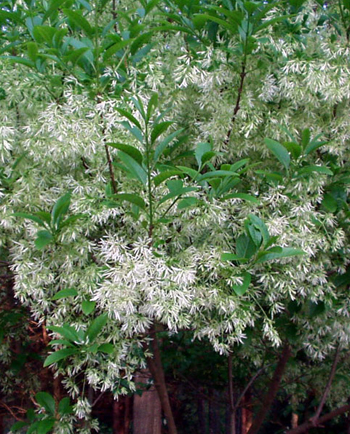
- Chionanthus virginicus L.
- Oleaceae
- Olive family
Common Names
- Gray beard tree
- Old man’s beard
- Poison ash
- Snowdrop tree
- Snowflower
- White fringe
Parts Usually Used
Root bark, trunk bark
Back to Top
Description of Plant(s) and
Culture
Fringe tree reaches 8-25 feet in height; the leaves are opposite, smooth, and oblong to oval in shape, grow 8 inches long. In May and June, when the leaves are only partially developed, the fragrant, slender-petaled, white flowers, from whose fringe-like petals the tree derives its name, appear in dense, drooping, panicles. The fruit is an oval, purple drupe, resemble small olives.
Other varieties: Leaves of the Chinese species (C. retusus) have been used in Asia as a tea substitute.
Back to Top
Where Found
Grows in the middle and southern United States and in New England. Cultivated in parks and gardens, dry slopes, and occurs wild along riverbanks and on higher ground. New Jersey to Florida; Texas, eastern Oklahoma, north to Missouri, southern Ohio.
Back to Top
Medicinal Properties
Alterative, aperient, cholagogue, diuretic, febrifuge, hepatic, laxative, tonic
Back to Top
Biochemical Information
Glycoside phyllirine, saponin
Back to Top
Legends, Myths and Stories
Native Americans and early colonists were familiar with fringe tree’s healing virtues. Migraine sufferers were amazed at the results of treatment.
Back to Top
Uses
Bark tea reduces fevers, relieves dyspepsia, and is beneficial for kidneys and liver inflammations including liver cirrhosis, acts as a cathartic, jaundice, gallstones, stimulates bile secretion, treats hepatitis, colic, headache, migraines, malaria, and used as a tonic. The bark made into a poultice is used externally on wounds, sores, infections, and skin irritations.
Back to Top
Formulas or Dosages
Decoction: boil 1 tsp. bark in 1 cup water. Take 1 cup per day.
Tincture: take 7-10 drops in water, as indicated.
Physicians formerly used 10 drops every 3 hours, of tincture for jaundice. Prepare tincture: 1 part bark by weight in 5 parts 50% grain alcohol (not rubbing alcohol which is poisonous if taken internally) and water.
Back to Top
Warning
Overdose may cause vomiting, frontal headaches, slow pulse.
Back to Top
Bibliography
 American Folk Medicine
Back to Eden
The Complete Medicinal Herbal
Eastern/Central Medicinal Plants
The Herbalist Almanac
The Herb Book
Indian Herbalogy of North America
The Magic of Herbs in Daily Living
Planetary Herbology
Webster’s New World Dictionary
